Camera & Accessories – Capture Every Moment with Confidence
Cameras have become an essential part of modern life. Whether you are a professional photographer, content creator, traveler, student, business owner, or someone who simply enjoys capturing special moments, the right camera and accessories can make a significant difference in image and video quality. From professional DSLR and mirrorless cameras to compact digital cameras, action cameras, lenses, tripods, memory cards, and lighting equipment, there are many products available to meet different photography and videography needs.
Choosing the right camera is only the beginning. A complete camera setup often requires several accessories that improve stability, storage, lighting, audio quality, protection, and overall shooting performance. Understanding these products can help you build a reliable setup that matches your skills, creative goals, and budget.
Why Cameras Are Important
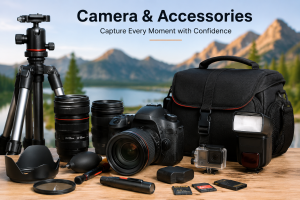
Camera & Accessories – Capture Every Moment with Confidence
Cameras allow us to preserve important memories and communicate ideas through visual content. A well-composed photograph can tell a story, while high-quality video can create an engaging experience for viewers.
Today, cameras are used for many purposes, including travel photography, weddings, product photography, wildlife photography, social media content, YouTube videos, filmmaking, journalism, and business marketing.
Modern cameras provide advanced features such as high-resolution sensors, fast autofocus, image stabilization, 4K video recording, wireless connectivity, and advanced shooting modes. These technologies make it easier for beginners to produce high-quality content while giving professionals greater creative control.
DSLR Cameras
DSLR cameras have been popular among photographers for many years. They use a mirror mechanism and interchangeable lenses, allowing photographers to choose lenses according to their specific needs.
One of the biggest advantages of DSLR cameras is their flexibility. A photographer can use a wide-angle lens for landscapes, a telephoto lens for wildlife, or a specialized macro lens for close-up photography.
DSLR cameras are suitable for portraits, events, landscapes, sports, wildlife, and professional photography. Although mirrorless cameras have become increasingly popular, DSLRs remain useful for photographers who value their optical viewfinders, extensive lens options, and familiar controls.
Mirrorless Cameras
Mirrorless cameras have become one of the most popular choices for modern photographers and content creators. Unlike DSLR cameras, mirrorless models do not use a traditional mirror mechanism.
Their compact design, advanced autofocus, high-quality video capabilities, and electronic viewfinders make them attractive for photography and videography.
Many mirrorless cameras offer excellent image quality while being smaller and lighter than comparable DSLR systems. This makes them particularly useful for travel photographers, vloggers, filmmakers, and creators who need a portable setup.
Action Cameras
Action cameras are designed for active lifestyles and challenging environments. They are commonly used for travel, cycling, hiking, swimming, sports, adventure activities, and outdoor content creation.
Their small size makes them easy to carry, while rugged construction allows many models to handle demanding conditions. Wide-angle lenses can capture immersive footage, making action cameras popular among vloggers and adventure enthusiasts.
Some models also provide image stabilization and high-resolution video recording for smoother and more detailed footage.
Camera Lenses
A camera body is important, but the lens plays a major role in determining the final image. Different lenses are designed for different types of photography.
Wide-angle lenses are useful for landscapes, architecture, interiors, and large group photographs. Standard lenses are versatile and can be used for everyday photography. Telephoto lenses are ideal for wildlife, sports, and subjects that are far away.
Macro lenses are designed for extremely close-up photography, allowing photographers to capture detailed images of flowers, insects, products, and other small subjects.
Choosing the right lens depends on the type of photography you enjoy and the results you want to achieve.
Tripods and Camera Stands
A tripod is one of the most useful accessories for photographers and videographers. It provides stability and helps prevent camera shake, particularly when using slow shutter speeds or recording stationary video.
Tripods are useful for landscape photography, night photography, product photography, portraits, time-lapse videos, and studio work.
For travel photographers, lightweight and compact tripods are convenient. For professional studio or video work, heavier and more stable models may provide better support.
Memory Cards
A reliable memory card is essential for storing photographs and videos. High-resolution images and 4K or higher-resolution videos can consume significant storage space.
When choosing a memory card, users should consider storage capacity, read and write speeds, compatibility, and reliability. Faster cards are particularly important for continuous shooting and high-resolution video recording.
It is also a good idea to keep additional memory cards available during important events such as weddings, trips, or professional photo sessions.
Camera Batteries and Chargers
Extra batteries are extremely useful for photographers who spend long periods away from power outlets. Battery life can vary depending on camera settings, temperature, video recording, screen usage, and other factors.
Carrying a spare battery can prevent interruptions during important shooting sessions. A reliable charger is equally important for keeping batteries ready for use.
For travel and outdoor photography, portable power banks and compatible charging solutions can also provide additional convenience.
Camera Bags and Backpacks
A camera bag protects valuable equipment while making transportation easier. Camera bags are available in many designs, including shoulder bags, backpacks, sling bags, and hard protective cases.
A good camera bag should provide adequate space for the camera body, lenses, batteries, memory cards, and other accessories. Padded compartments can help protect equipment from scratches and accidental impacts.
For travel photographers, weather-resistant bags can provide additional protection against rain, dust, and outdoor conditions.
Camera Lighting Equipment
Good lighting can dramatically improve photography and video quality. Natural light is useful in many situations, but artificial lighting provides greater control.
External flashes can provide additional illumination for indoor photography and events. LED lights are popular among content creators, vloggers, product photographers, and video makers because they provide continuous lighting.
Softboxes, ring lights, reflectors, and light stands can also help create more professional-looking images and videos.
Camera Microphones
For video creators, good audio is just as important as good visuals. Built-in camera microphones can be useful, but external microphones can provide clearer and more professional sound.
Shotgun microphones are commonly used for cameras and video production, while wireless microphone systems are popular for interviews, presentations, and vlogging.
When recording videos for social media, YouTube, or business marketing, improving audio quality can make the content more enjoyable and professional.
Camera Filters
Camera filters are accessories that attach to the front of a lens and can affect the way light enters the camera.
UV filters can provide additional protection for the front element of a lens. Polarizing filters can help reduce reflections and enhance contrast in certain outdoor situations. Neutral density filters can reduce the amount of light entering the lens, allowing photographers to use slower shutter speeds or wider apertures in bright conditions.
Filters can therefore be useful creative and protective tools when used correctly.
Camera Cleaning Accessories
Keeping camera equipment clean is essential for maintaining image quality and protecting expensive equipment.
Dust, fingerprints, and dirt can affect lenses and camera sensors. Basic cleaning kits may include microfiber cloths, air blowers, lens-cleaning brushes, and specialized cleaning solutions.
Users should always follow appropriate cleaning procedures and avoid using unsuitable materials that could damage delicate surfaces.
Camera Accessories for Content Creators
Content creators often need a combination of equipment rather than just a camera. A typical creator setup may include a camera, versatile lens, tripod, external microphone, LED light, memory card, extra battery, and camera bag.
For vloggers, portability and ease of use are particularly important. For studio creators, lighting, audio, and stable camera positioning may be more important.
The best setup depends on the type of content being created and the environment where the camera will be used.
How to Choose the Right Camera and Accessories
Before buying camera equipment, identify your main purpose. A beginner taking family photographs may not need expensive professional equipment. A wedding photographer, filmmaker, or professional content creator may require more advanced equipment.
Consider image quality, video resolution, autofocus performance, lens availability, battery life, portability, connectivity, and overall budget.
It is also important to think about accessories as part of the complete system. A high-quality camera with insufficient storage, poor lighting, unstable support, or weak audio may not produce the desired results.
Reading product specifications and customer reviews can help you make an informed decision.
Protecting Your Camera Equipment
Camera equipment can be expensive, so proper care is important. Keep cameras and lenses in protective bags when they are not being used. Avoid exposing equipment to unnecessary moisture, extreme temperatures, dust, or physical impacts.
When traveling, use padded compartments and protective cases whenever appropriate. Regularly check batteries, memory cards, cables, and lenses to make sure everything is working properly.
Backing up important photographs and videos is also essential. Important files should ideally be stored in more than one location to reduce the risk of losing valuable memories or professional work.
The Future of Camera Technology
Camera technology continues to evolve rapidly. Artificial intelligence, advanced autofocus, computational photography, improved stabilization, higher-resolution video, and better wireless connectivity are changing the way people capture and share visual content.
Smart features can help cameras recognize subjects, track moving objects, and automatically optimize certain settings. At the same time, compact cameras and smartphones continue to make high-quality photography accessible to more people.
As technology advances, cameras and accessories will likely become more powerful, portable, and user-friendly.
Conclusion
Camera and accessories work together to create a complete photography and videography experience. Whether you are capturing family memories, creating social media content, traveling around the world, photographing products, or working professionally, the right equipment can help you achieve better results.
A good camera provides the foundation, while lenses, tripods, memory cards, batteries, lighting, microphones, bags, and other accessories add flexibility and convenience. By choosing equipment based on your specific needs, skill level, shooting environment, and budget, you can build a camera setup that supports your creative goals.
With the right tools and a little practice, anyone can capture memorable photographs and engaging videos that last for years.